
President Pranab Mukherjee on Monday addressed the first joint sitting of Parliament as mandatorily required under the Constitution after the general elections. The address is the political, economic and foreign policy road map of the Narendra Modi government and covers virtually all crucial areas.

'With the recent challenging of the notion of the Indian Ocean Region being India's strategic backyard, China is gradually upping the ante in the maritime realm around India.'
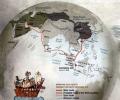
China's desire to have India as part of its ambitious Maritime Silk Route makes strategic sense for both nations. However, it would involve substantive assurances from Beijing, says Dr Rahul Mishra
It will be difficult for the Indian equity to outperform overall growth to the extent bullish observers expect.
'Modi and Abe are working seriously for India-Japan bonhomie to grow stronger.' 'It is a win-win situation for both countries and the future look promising,' says Rajaram Panda, the Indian Council for Cultural Relations India Chair Visiting Professor at Reitaku University, Japan.

'The real test will be in defence-related deals, for instance the Javelin anti-tank missile: Is the US willing to co-develop something with India, on terms that will support the 'Make in India' initiative? Is there defence technology transfer? Or will it dump old junk on India?' asks Rajeev Srinivasan.

'In a relationship that does not permit cricket, how can the prime ministers embrace and send a false message,' asks Ambassador T P Sreenivasan.

'The Modi-Xi and Modi-Obama meetings, with an interval of just 12 days, are juxtaposed superbly at a crucial point in the prime minister's life. Can Modi carve out a win-win situation with the superpower and the emerging superpower at the same time?'

'The US wants Modi to succeed because we want India to succeed. For our part, when India thinks of its partners in the world, we want it to think of the US first. That means positioning our country as the preferred provider of the key inputs that can help to propel India's rise.' 'The meeting between Modi and Obama is, and must be, an opportunity for true strategic dialogue -- not a scripted exchange of talking points, but an open discussion of the big questions. What kind of world do we want to live in? What are our true priorities? And most importantly, why does this partnership still matter?'

The Geneva agreement is a signal, which at least Saudi Arabia and Israel are so reading, that normalisation of relations between US and Iran is not merely about the nuclear fuel cycle, says K C Singh.

'Clearly, from the Indian viewpoint, the US retrenchment from Asia cannot be happening as good news.' 'The abandonment of the US' pivot to Asia exposes the US-Indian partnership to be a mere transactional relationship,' says Ambassador M K Bhadrakumar

President Xi Jinping's visit may put relations between India and China on a new trajectory

Was the Modi-Obama summit the panacea for all that troubles the India-US relationship?

'India's economy is growing faster compared to the developed economies of the world.' 'More importantly, it is growing faster compared to most of the developing economies.' 'The monsoon is not the only thing that drives the rural economy and certainly not the national economy.' 'It is too simplistic to reduce everything to the monsoon.'

'We want to provide data, we want to provide consultation, but we don't want to lecture.' 'The consciousness about this issue in India is starting to get quite high and if we can help contribute to solving this air quality issue in a spirit of partnership with the Indians, it would be a big achievement.'
'Pakistan's capacity to carry a normal relationship with India doesn't exist.' 'The relationship with Pakistan is less important than several others.'

'The diplomat's arrest has led to a major diplomatic spat, the likes of which I have not seen in my nearly three decades of covering the US-India relationship, says Aziz Haniffa. 'The knee-jerk reaction by the powers-that-be in Delhi was myopic to say the least.'

Council on Foreign Relations Senior Fellow Daniel Markey Tuesday said that the raising of the issue of American intervention in Jammu and Kashmir by visiting Pakistani Prime Minister Nawaz Sharif at the United States Institute of Peace in Washington was not 'especially constructive' and was motivated by political expediency.

As India gears up to honour its pravasis on January 9 to mark their contribution in the nation's development, rediff.com presents perspectives from eminent writers on the Diaspora. Kicking off the series is Ambassador T P Sreenivasan, who points out that the change of the Diaspora policy put in place by Rajiv Gandhi following the military coup in Fiji and his decision to stand by them, was the one defining moment in India's dealings with its overseas family.

AAP candidates from Mumbai, Medha Patkar and Meera Sanyal, are poised to play a crucial and complementary role. While Patkar gives voice to the suffering of people at the grassroots, Sanyal is articulating the key principles that could build a more just and equitable society or economy, says Rajni Bakshi.

If Indian PM boycotts the CHOGM, it is likely to add to Sri Lanka's bitterness. This would not help India's desire to add more depth and content to its relations with Sri Lanka but its ability to influence Sri Lanka's decision making process on the both strategic issues and on Tamil minority issues, says Colonel (retd) R Hariharan.
'We are encouraged by what the prime minister said recently on these issues... We will keep a close eye on these issues. They are very important and as are other elements of our human rights and religious freedom.' 'So, absolutely, we'll keep a focus on them.'

If the impact of the Greece crisis spreads across Europe and parts of the world which are more interconnected than ever before, India cannot hope to be insulated, says Paranjoy Guha Thakurta.

Few readers will remember the socialist utopia of Indira Gandhi when food queues were the norm even for the middle class and tankers supplied water at odd hours of the night twice a week. Is that what you are trying to return us to, dear Congress, asks Jaideep Prabhu

'The question now is how long the exercise in perfection he created will last once his influence isn't there any longer,' says Sunanda K Datta-Ray.

The Forbes 30 Under 30 list is harder to get into than Stanford or Harvard University. Meet the desis who made the cut this year.
'A change of government will bring about a lot of changes because everything is frozen for the last two years. So, the frozen energies of India will be released.' Swadeshi Jagran Manch convenor Swaminathan Gurumurthy discusses the Modi phenomenon with Shobha Warrier/Rediff.com
Arvind Subramanian talks about US and China's power play and where India figures in these dynamics.

'It is a pattern of behaviour of the Chinese that whenever a Chinese leader visits India or an Indian leader visits China, some incidents take place.' 'When Modi visits China, we should look out for some similar demonstration by the Chinese.'

Indian intelligence agencies have often claimed that left-wing extremists are trying to make inroads in the militancy-hit regions of north-east to foment further unrest. But Jaideep Saikia, noted terrorism and conflict analyst, claims, "People who speak of Maoism taking roots in the north-east have not read history".
 © 2026 Rediff.com - Advertise with us - Disclaimer - Privacy Policy - Sitemap - Feedback - About us - Terms of use - Grievances